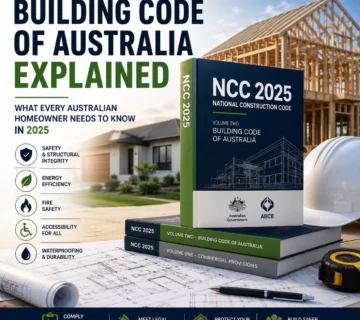

Do Home Renovations Need to Comply with the Latest Building Code in Australia? Renovating your home in Australia can be an exciting investment—whether you’re extending your living space, adding a second storey, converting a garage, or modernising an older dwelling. However, one of the most common and critical questions homeowners ask is:
Do home renovations need to comply with the latest Building Code of Australia (BCA)?
The short answer is yes—new works must comply, but the reality is more nuanced. Understanding how the Building Code of Australia (now part of the National Construction Code – NCC) applies to renovations, alterations, and additions can save you time, money, and costly compliance issues down the track.
This guide explains everything homeowners need to know—clearly, practically, and in line with current Australian planning and building regulations.
Understanding the Building Code of Australia (BCA)
The Building Code of Australia (BCA) forms part of the National Construction Code (NCC) and sets the minimum technical standards for:
Structural safety
Fire protection
Health and amenity
Energy efficiency
Accessibility
Waterproofing and durability
The NCC applies nationally, but each state and territory adopts and enforces it differently, often with additional local requirements.
For residential projects, the key volumes are:
NCC Volume Two (Housing Provisions) – Class 1 & Class 10 buildings
NCC Volume One – Class 2 (apartments) and mixed-use developments
Are Existing Homes Required to Meet the Latest BCA?
Existing Buildings Are “Grandfathered”
If your home was lawfully approved and built under the BCA in force at the time of construction, it is generally considered compliant—even if the code has since changed.
This means:
You do not need to upgrade your entire house every time the BCA is updated.
Older homes are legally allowed to remain as they are.
However, this protection applies only to the existing structure, not to new works.
Do Renovations and Additions Need to Comply with the Current BCA?
Yes—All New Building Work Must Comply
Any new building work must comply with the current version of the BCA/NCC at the time of approval, including:
Home extensions
Second-storey additions
Garage conversions
Granny flats / secondary dwellings
Major internal alterations
Structural modifications
This applies whether the approval pathway is:
Development Application (DA)
Complying Development Certificate (CDC)
How the BCA Applies to Renovations in Practice
1. New Work Must Meet Current Standards
The altered or added parts of the home must comply with:
Current structural codes
Fire separation and safety
Energy efficiency requirements
Waterproofing and moisture control
Ventilation and ceiling height standards
Even if the rest of the house was built decades ago, the new work must meet today’s rules.
2. New Work Must Not Reduce Existing Compliance
A critical principle of the BCA is:
Renovations must not make the existing building less compliant than it was before.
For example:
A new extension must not compromise fire separation distances.
Changes to layouts must not block exit paths.
Structural loads from new floors must not overstress existing walls or footings.
In some cases, this can trigger upgrades to adjacent existing areas.
Energy Efficiency: A Major Trigger in Renovations
Energy efficiency is one of the most common areas where renovations must comply with the latest standards.
Current Requirements May Include:
Improved insulation
Upgraded glazing performance
Sealing of doors and windows
Energy-efficient lighting
Efficient hot water systems
In NSW, BASIX often applies even to smaller renovations, requiring:
Thermal performance compliance
Water efficiency targets
Energy usage benchmarks
This is where many homeowners get caught out—assuming “small works” are exempt when they’re not.
Structural Compliance for Home Alterations
When Structural Standards Apply
Structural compliance is mandatory for:
Removing load-bearing walls
Adding upper levels
Enlarging openings (sliding doors, stairs)
Building on reactive soil sites
Key standards include:
AS 2870 – slabs and footings
AS 1684 – timber framing
AS/NZS 1170 – structural loads
In many renovation projects, engineering design and certification is required—even for residential homes.
Fire Safety and Renovations
Fire safety requirements often change between BCA versions, and renovations must comply with current rules, including:
Fire separation to boundaries
Fire-rated construction between house and garage
Smoke alarm upgrades in altered areas
Fire protection for new stairways or upper floors
For attached garages or Class 10 structures, additional separation rules often apply.
Accessibility: Do Renovations Need to Comply?
New accessibility standards (based on Livable Housing Design Guidelines – Silver Level) apply to new dwellings, but:
Some renovations may trigger partial compliance
Multi-residential or mixed-use projects may require stricter access provisions
Council or certifier discretion often applies
Professional planning advice is essential here.
Performance Solutions and Renovations
In constrained or older homes—especially heritage properties—full compliance may not always be practical.
The NCC allows for Performance Solutions, where:
Equivalent or better outcomes are demonstrated
Solutions are supported by evidence (engineering, modelling, expert reports)
This is commonly used for:
Heritage homes
Narrow sites
Inner-city renovations
Structural constraints
Council and Certifier Discretion
Local councils and private certifiers have authority to:
Interpret compliance pathways
Accept performance-based approaches
Request additional upgrades where necessary
This is where experience with local councils makes a significant difference.
Common Renovation Mistakes Homeowners Make
❌ Assuming old approvals still apply
❌ Starting construction without checking BCA implications
❌ Underestimating energy efficiency requirements
❌ Skipping engineering advice
❌ Using non-compliant designs to save costs
These mistakes often result in:
Approval delays
Costly redesigns
Compliance notices
Insurance issues
Why Professional Planning Advice Matters
Renovations are no longer “simple building works.” Today’s regulatory environment requires a strategic approach that balances:
Planning controls
BCA compliance
Energy efficiency
Structural integrity
Council expectations
At Residential Plannings, we specialise in guiding homeowners through this complexity with confidence.
Why Choose Residential Plannings?
We provide expert planning and compliance support for residential renovations across NSW, including:
✔️ BCA & NCC compliance advice
✔️ DA & CDC documentation
✔️ Statement of Environmental Effects
✔️ Heritage Impact Statements
✔️ Council coordination & approvals
✔️ Energy and structural compliance strategy
With extensive experience working with inner Sydney and metropolitan councils, we ensure your renovation is approved faster, designed smarter, and fully compliant.
🔗 Learn more at: https://residentialplannings.com.au/
So, do home renovations need to comply with the latest Building Code of Australia?
✔️ Existing homes are protected under the code they were built to
✔️ All new work must comply with the current NCC/BCA
✔️ Renovations can trigger upgrades—especially for energy, structure, and fire safety
✔️ Professional advice is essential to avoid costly mistakes
If you’re planning a renovation, extension, or alteration—get expert advice early. It’s the smartest investment you can make before construction begins.
✅ FAQ Section
❓ Do home renovations in Australia need to comply with the latest Building Code?
Yes. While existing homes are generally assessed under the building code in force at the time they were built, all new renovation works must comply with the current Building Code of Australia (NCC) at the time of approval.
❓ Are CDC renovations required to meet current BCA requirements in NSW?
Yes. All CDC renovations in NSW must comply with the current NCC/BCA, as well as BASIX and relevant Australian Standards. Compliance is assessed by a certifier before approval is issued.
❓ Do small renovations need BCA compliance in NSW?
In many cases, yes. Even minor renovations can trigger:
Energy efficiency upgrades
Fire separation requirements
Structural compliance
This is particularly common for CDC renovations and BASIX-affected works.
❓ Does BCA compliance apply to internal renovations only?
If the renovation involves structural changes, services, energy performance, or fire safety, BCA compliance is required—even for internal works.
❓ Can older homes avoid upgrading to new BCA standards?
Older homes are generally “grandfathered.” However, new works must comply, and renovations must not reduce the existing building’s compliance or safety.
❓ Do renovations require engineering approval under the BCA?
Yes, especially for:
Load-bearing wall removal
Second-storey additions
Large openings
Reactive soil sites
Engineering certification is often mandatory.