Fire safety has always been a cornerstone of the Building Code of Australia (BCA), but with the upcoming NCC 2025 edition, the rules are tightening further.
From single dwellings to multi-residential apartments, every project — whether new or altered — will face stronger standards for fire resistance, separation, and occupant safety.
This guide from Residential Plannings breaks down the current fire safety provisions under NCC 2022, and the proposed new changes for NCC 2025 that architects, designers, and builders need to prepare for.
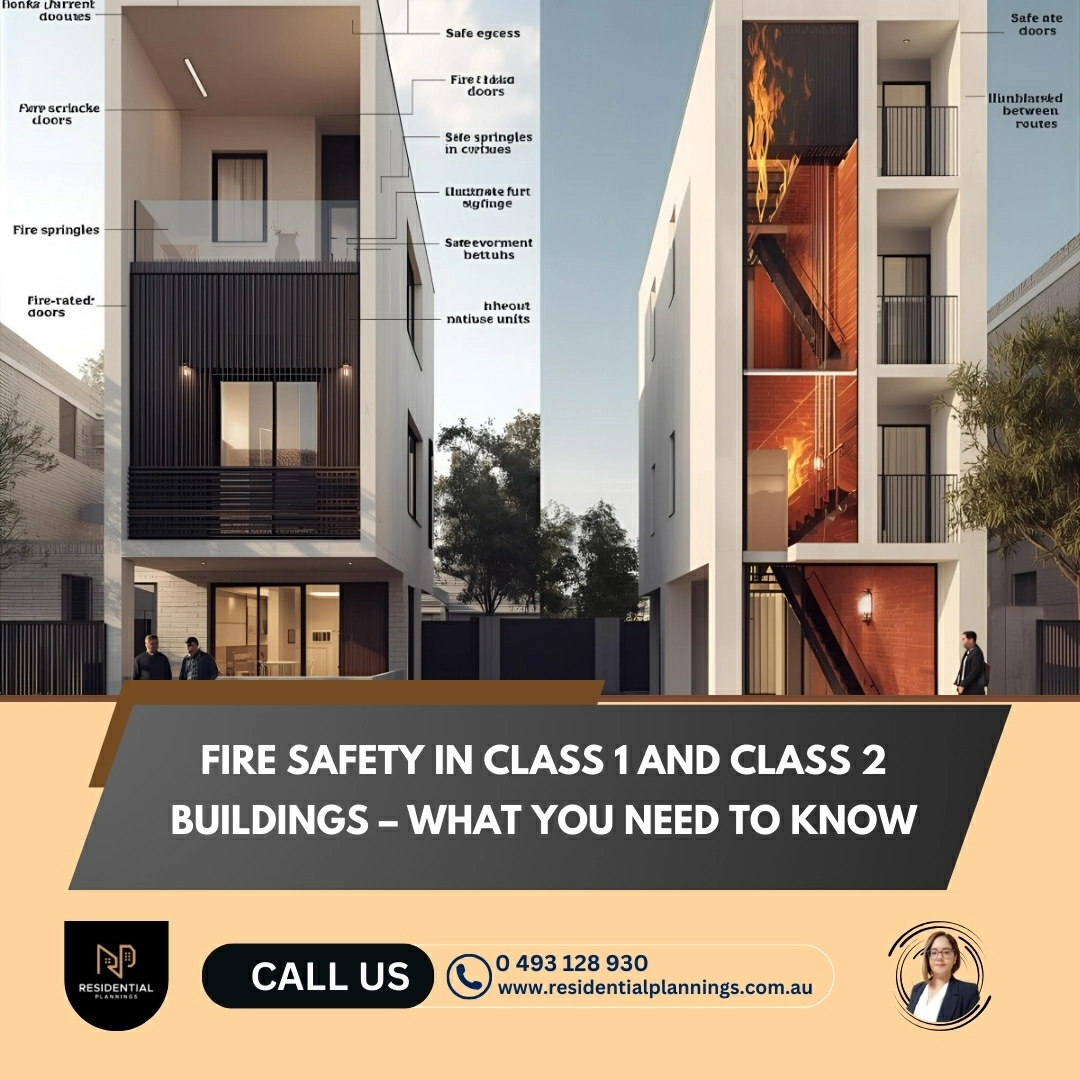
🔥 Fire Safety in Class 1 and Class 2 Buildings – What You Need to Know
The National Construction Code (NCC) divides buildings into classes based on their use.
Class 1 covers typical houses and townhouses, while Class 2 covers apartment buildings and other multi-residential structures.
Each class has unique fire safety objectives, balancing prevention, containment, and safe evacuation.
🏡 Class 1 Buildings (Houses / Townhouses)
Under Volume Two – Housing Provisions (Part H3 Fire Safety) of the NCC 2022, Class 1 buildings must meet several critical fire safety obligations.
1️⃣ Automatic Warning and Smoke Alarms
Every Class 1 dwelling must include automatic smoke alarms that:
- Provide an audible warning throughout the home.
- Allow occupants to evacuate safely in the event of fire.
- Are interconnected across multiple storeys and rooms.
2️⃣ Fire Spread and Boundary Separation
To prevent fire from spreading between properties:
- External walls near a boundary must meet minimum fire-resistance levels (FRLs).
- Windows and openings facing another property are limited in size or require fire-rated glazing.
- Fire separation is also required between a Class 1 dwelling and any Class 10 structure (like garages or sheds) on the same site.
3️⃣ Fire Separation of External Walls
The Housing Provisions Part 9.2 provides detailed rules for:
- How close external walls can be built to boundaries.
- The materials and claddings permitted within fire-prone distances.
- Allowable encroachments, eaves, and projections that do not compromise fire performance.
4️⃣ Deemed-to-Satisfy (DTS) Construction Methods
Builders can follow Deemed-to-Satisfy (DTS) solutions to ensure compliance.
These include:
- Fire-rated plasterboard systems.
- Non-combustible cladding and roofing.
- Prescribed distances between openings and property boundaries.
5️⃣ Interface with Class 10 Structures
Garages, carports, and sheds can create hidden fire hazards.
Where they are attached to or near a Class 1 dwelling, they must be fire-separated with rated walls or ceiling linings to prevent ignition transfer.
🏢 Class 2 Buildings (Apartments / Multi-Residential)
For Class 2 buildings, the BCA’s Volume One applies — setting out far stricter performance expectations due to their multi-occupancy nature.
1️⃣ Fire-Resistance Levels (FRLs)
- All structural components (walls, floors, beams, and columns) must meet specific fire-resistance ratings.
- The required FRL depends on the building height, use, and construction type.
- High-rise Class 2 buildings must resist fire spread for longer durations to ensure occupant safety and evacuation time.
2️⃣ Fire Compartmentation and Separation
- Individual units, stairwells, corridors, and service risers must be fire-separated using rated walls and floors.
- This compartmentation slows fire spread and limits smoke transmission between apartments.
3️⃣ Protection of Openings
- Windows and doors that open onto fire-isolated zones must use fire-rated assemblies or self-closing mechanisms.
- External openings near property boundaries require protection from radiant heat and flame exposure.
4️⃣ Egress and Evacuation Design
- Fire-isolated stairwells, exit routes, and emergency lighting are mandated for safe occupant egress.
- Clear exit signage, wayfinding systems, and pressurised stairwells ensure visibility and breathable air during evacuation.
5️⃣ Fire Brigade Access and Equipment
Depending on building scale, Class 2 developments must include:
- Fire hydrant and hose reel systems
- Fire detection panels and sprinkler systems
- Emergency lifts or fire-fighter access points
🆕 NCC 2025: Proposed Fire Safety Changes for Class 1 & Class 2 Buildings
The NCC 2025 public draft introduces several major adjustments to strengthen Australia’s fire resilience — particularly in response to electric vehicle (EV) risks and multi-storey developments.
1️⃣ Stricter Fire Safety for Carparks and Vehicle Areas
As EVs become common, their high battery heat output requires:
- Enhanced sprinkler systems for enclosed or open-deck carparks.
- Fire suppression for car stackers and automated parking systems.
- New fire-resistance benchmarks for walls and ceilings adjacent to parking zones.
This is one of the most significant shifts in carpark fire safety NCC 2025 and car stacker fire protection design.
2️⃣ Reduced Concessions for Verandas, Balconies, and Projections
NCC 2025 proposes to limit the exemptions that previously allowed verandas, eaves, or awnings to bypass fire separation rules.
Designers will now need to ensure these elements do not compromise wall fire performance or contribute to upward flame spread.
3️⃣ Stronger Scrutiny of Fire Performance Solutions
Fire safety performance solutions (alternative methods to prescriptive DTS paths) will require:
- Independent verification testing
- Quantitative performance modelling
- Documented evidence of equivalence
This reduces reliance on subjective “expert judgment” and ensures consistency across jurisdictions.
4️⃣ Material and Condensation Interactions
Though primarily part of waterproofing and condensation reforms, wall cavity and moisture management updates in NCC 2025 also affect fire detailing — requiring careful coordination of vapour barriers, claddings, and insulation to avoid compromising fire safety.
5️⃣ Fire Egress and Accessibility Alignment
Updates to the Premises Standards (AS 1428.1:2021) for accessibility will influence:
- Corridor widths
- Exit clearances
- Emergency signage placement
Designers must balance accessibility compliance with safe evacuation requirements under NCC 2025.
🔍 Why These Changes Matter
Australia’s evolving urban and environmental landscape has introduced new fire challenges — from denser housing to electric mobility and climate extremes.
The NCC 2025 fire safety provisions aim to:
- Protect life and property.
- Improve building resilience to new fire sources.
- Ensure consistent compliance across Class 1 and Class 2 developments.
Whether you’re designing a new home, planning an apartment project, or seeking to renovate an existing dwelling, understanding these rules is essential for compliance.
At Residential Plannings, we provide expert guidance on fire safety compliance, BCA documentation, and council approvals for both residential and mixed-use projects across NSW.
👉 Contact Residential Plannings today to ensure your design aligns with the Building Code of Australia 2025 fire safety requirements.
💬 Frequently Asked Questions (FAQ)
1️⃣ What are the current fire safety requirements for houses (Class 1)?
Smoke alarms, boundary fire separation, and rated wall construction are key requirements under NCC 2022.
2️⃣ What’s new for NCC 2025 fire safety?
Stricter standards for carparks, car stackers, and performance solution verification, plus tighter rules for verandas and projections.
3️⃣ Do the new fire safety provisions affect apartments (Class 2)?
Yes. Expect stronger FRLs, improved smoke control, and enhanced egress design to align with modern fire risks.
4️⃣ Will existing houses need to upgrade to NCC 2025 fire rules?
Only new or altered work must comply; existing dwellings remain valid under previous BCA editions unless modified.
5️⃣ How can I ensure my design complies?
Work with a qualified town planner or certifier to confirm compliance pathways early in the design stage.